

Dr. Mike Peasgood: From Building Robots as a Kid to Founding Two Companies That Changed How We Think About Autonomy
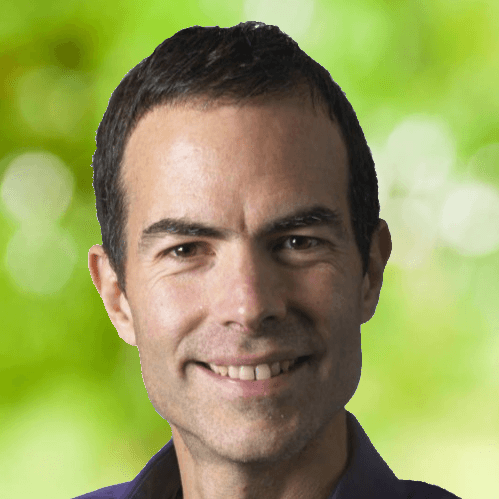
Most founder stories start with the company. Mike’s started when he was a kid, spending most of his time building things that moved — better yet, things that moved on their own. That fascination with autonomy led him to Systems Design Engineering, where he focused on robotics and control systems, and built a walking robot as one of his undergraduate projects.
Returning to the University of Waterloo for graduate research, he focused on teams of multiple robots, coordinating their planning to complete missions collaboratively. Taking that research into the air led to co-founding Aeryon Labs, and his role as Chief Roboticist leading an amazing team of talented control systems engineers and designers. As CEO of ENVGO, a Canadian marine technology company, he continues the focus on building companies with world-class technical leadership.
From Experimenting with Robots and Sailing to the Systems Design Lab
Besides building autonomous robots, Mike grew up sailing, developing an early feel for the interplay between a vessel, the forces acting on it, and the constant small interventions needed to keep it going where you want. He pursued that intuition formally at the University of Waterloo, where he completed three degrees in Systems Design Engineering: a Bachelor of Applied Science in 1998, a Master of Applied Science in 2004, and his Ph.D. in 2008.
His graduate research focused on mobile robotics and real-time control systems — the mathematical foundations for building machines that can sense their environment and stabilize themselves in it faster than any human could react. The Systems Design Engineering program shaped more than his technical skills.
"Rather than considering components in isolation, the systems designer is required to make multi-disciplinary trade-offs," he has explained. "That perspective was critical in developing a reliable hydrofoiling platform."
It's an engineering philosophy that runs through every product he has built: not the best motor, or the best sensor, or the best software in isolation — but the best integrated system, where the trade-offs across disciplines are deliberately managed. That is what autonomous vehicles require, and it is what Waterloo's Systems Design program is built to produce.
Aeryon Labs: Nearly Two Decades in the Air
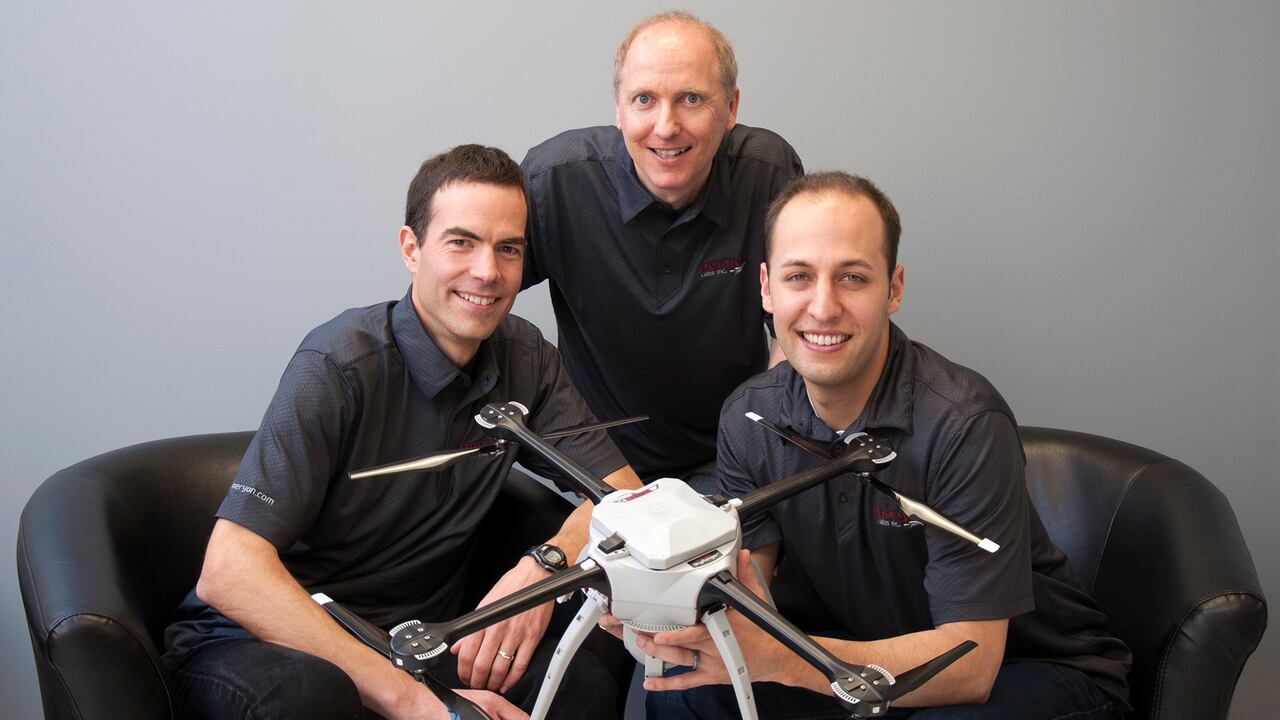
In 2007, Mike co-founded Aeryon Labs with Dave Kroetsch and Steffen Lindner, fellow Waterloo researchers who saw that drone technology was approaching commercial viability and that the same control systems research coming out of the university could be applied to real-world, safety-critical deployments. Over the next twelve years, Aeryon's unmanned aerial systems were deployed by defence forces, police services, and emergency response agencies across more than 35 markets worldwide. Twenty militaries, including the US Department of Defense, trusted Aeryon's SkyRanger aircraft. Canadian police forces used them for missing persons searches and accident reconstruction. The aircraft were deployed in disaster zones on multiple continents.
In January 2019, Aeryon Labs was acquired by FLIR Systems for approximately $200 million USD — to this day, the largest VC-backed startup exit in Canada. The acquisition validated not just a financial return but a thesis: that a university research lab in Waterloo could build autonomous systems trusted by the most demanding operators in the world and scale them globally.
For most founders, that would be the chapter that defines a career. For Mike, it was just the beginning.
The Problem That Launched ENVGO
After the FLIR acquisition, Mike spent time reflecting on where the same approach, applying rigorous autonomous systems engineering to an underserved market, could have the most impact next. The answer came from personal frustration with boats.
"I love my electric car experience because I never have to go to a gas station and the performance is amazing," he has said. "But I didn't find any equivalent in the boating world. Almost all new boats are still gas powered." The reason, he found, was physics. Boats require dramatically more power than cars due to the drag of pushing a hull through water which has slowed electrification across the marine sector in a way the automotive and aerospace industries have largely overcome. Rather than working around that constraint, Mike went back to first principles.
"I wanted to create a better solution for high-performance electric boats," he has explained. "It led to a whole different approach to boat design: a hydrofoiling boat which uses a wing below the surface to lift the hull and fly over the waves."
By raising the hull out of the water, hydrofoiling eliminates the drag equation that makes conventional electric boats impractical at speed. The is a hydrofoil vessel that can achieve the performance of a combustion boat: 80 km/h, 100 km range, 330 hp, while running entirely on electric power.
In 2021, Mike assembled some core people from his Aeryon days and founded ENVGO in Waterloo. The company's first proof-of-concept was a three-foot hydrofoiling model. It grew into a twelve-foot single-seat prototype where the team built the entire technology stack from helm to propeller. That led to the NV1 Founders Edition — the world's first performance-class electric hydrofoiling boat.

Mike and colleague Pete Keller in front of NV1 Founders Edition boat at the Palm Beach International Boat Show, March 2026
Why Hydrofoiling Is an Aerospace Problem, Not a Marine One
Mike's framing of ENVGO's core engineering challenge is precise and deliberate:
"It's not a marine design challenge. It's an aerospace design challenge."
A conventional boat gets its stability from hull contact with the water; take that away and you have an unstable platform that needs active, high-frequency control to remain upright, exactly like a quadrotor drone.
NV1's self-stabilizing avionics make 250 automated foil adjustments per second, fusing data from an IMU, GPS, radar, sonar, and a six-camera AI vision system, the same class of sensor fusion and real-time control that Mike's team built for Aeryon's unmanned aircraft over a decade of operational deployment.
The experience that results is qualitatively different from anything a conventional boat delivers. "It creates an amazing feeling of flight over water that feels more like flying a plane instead of crashing over waves," Mike describes.
The hull rises above the chop entirely. Waves pass underneath. The ride is near- silent and smooth in a way that conventional boats which pound and slam through every wave they meet simply cannot match.
The multi-disciplinary systems design perspective Mike developed at Waterloo is central to how this is achieved. Hydrofoiling a boat is not a problem that can be solved by the best marine engineer, or the best controls engineer, or the best AI engineer working independently. It requires someone who can hold all of those disciplines simultaneously and make the right trade-offs across them. That is what twenty years of autonomous systems development, and three Waterloo engineering degrees, produces.
Canada's Maritime Security Opportunity
In 2026, ENVGO announced its expansion into defence and public safety with the XV2, a 2-metre unmanned surface vessel (a.k.a drone boat) for intelligence, surveillance, and reconnaissance (ISR) operations.
The strategic context is clear: Canada has more than 240,000 kilometres of coastline, the longest in the world, and faces growing demand for persistent, efficient maritime monitoring by the Coast Guard, Navy, and other agencies.
Conventional approaches to coastal surveillance are expensive, slow, crewed and emissions-heavy. ENVGO's autonomous hydrofoiling vessels offer a fundamentally different capability profile.
"Our designs for security and defence combine the speed and efficiency of hydrofoiling vessels with advanced autonomy and sensing capabilities to help organizations protect ports, harbours and coastlines without putting crews at risk," Mike has explained.
"What sets us apart is the ability to rapidly reach an area of interest … that's where our experience building high-performance hydrofoils gives us a unique advantage."
The move into defence is not a pivot. It is the application of the same team, the same technology, and the same customer relationships, built across 35+ markets during the Aeryon years, to a new platform and a new operational domain. The XV2 micro-USV builds on the autonomous control architecture proven in NV1, and goes into a defence market where ENVGO's team already has the relationships, the pedigree, and the credibility to sell.
Canada has committed to reducing emissions to 40 per cent below 2005 levels by 2030; electrifying government and defence marine fleets is part of how that target gets reached, and zero-emission autonomous vessels are uniquely positioned to serve both the sustainability and operational requirements those agencies face.
The Through-Line
From building robots as a kid, to three engineering degrees from the University of Waterloo, to co-founding one of Canada's most recognized unmanned systems companies and selling it for $200 million, to founding ENVGO and building the world's first performance-class electric hydrofoiling boat - Mike Peasgood's career has one consistent thread: a fascination with vehicles that don't want to stay upright, and the discipline to make them do it anyway, with hundreds of adjustments a second.
The systems design perspective shapes how he thinks about every problem: not as isolated engineering challenges, but as integrated systems where the trade- offs across disciplines have to be actively managed. That is what Waterloo trained him to do. It is what Aeryon required for twelve years. And it is what ENVGO demands now - applied, for the first time, to the water.
Frequently Asked Questions
What is Dr. Mike Peasgood's educational background?
Dr. Mike Peasgood holds three degrees in Systems Design Engineering from the University of Waterloo: a Bachelor of Applied Science (1998), a Master of Applied Science (2004), and a Ph.D. (2008). His graduate research focused on mobile robotics and real-time control systems — the foundational engineering disciplines behind both Aeryon Labs' unmanned aerial systems and ENVGO's electric hydrofoiling boats.
What did Mike Peasgood build before ENVGO?
Mike Peasgood co-founded Aeryon Labs in 2007, a Waterloo-based unmanned aerial systems company whose aircraft were deployed by militaries, including the US Department of Defense, and by government and public safety agencies across 35+ markets worldwide. Aeryon Labs was acquired by FLIR Systems in January 2019 for approximately $200 million USD, still the largest VC-backed defence startup exit in Canada.
Why did Mike Peasgood found ENVGO?
After the Aeryon Labs acquisition, Mike identified a fundamental gap in the marine industry: unlike the automotive and aerospace sectors, almost all new boats remained gas-powered. The physics of hull drag makes conventional electric boats impractical at performance speeds. His solution, a hydrofoiling boat that lifts the hull above the water to eliminate drag, reframes the problem as an aerospace engineering challenge, allowing the same autonomous systems expertise developed at Aeryon to be applied to the water.
What is ENVGO’s NV1 Founders Edition platform?
ENVGO’s NV1 is the world's first performance-class electric hydrofoiling boat. It reaches speeds of up to 80 kph (43knots), has a range of up to 100 km on a single charge, and delivers 330 hp while running entirely on electric power with zero direct emissions. Its self-stabilizing avionics make 250 automated foil adjustments per second using the same flight control principles as unmanned aerial systems.
What is ENVGO building for Canadian defence?
ENVGO is developing the XV2, a 2-metre unmanned surface vessel (micro-USV) designed for intelligence, surveillance, and reconnaissance (ISR) operations along Canada's 240,000+ km coastline, the longest in the world. XV2 applies the autonomous control technology proven in NV1 to a defence and public safety mission set, drawing on the team's prior experience deploying autonomous systems across 35+ markets at Aeryon Labs.
What is Mike Peasgood's connection to the University of Waterloo? Mike Peasgood completed all three of his engineering degrees — BASc, MASc, and Ph.D. — in Systems Design Engineering at the University of Waterloo. He credits the multi-disciplinary systems design approach as foundational to both Aeryon Labs and ENVGO: "Rather than considering components in isolation, the systems designer is required to make multi-disciplinary trade-offs. That perspective was critical in developing a reliable hydrofoiling platform."